Stop 8 of 8
Finishing
Where to stand
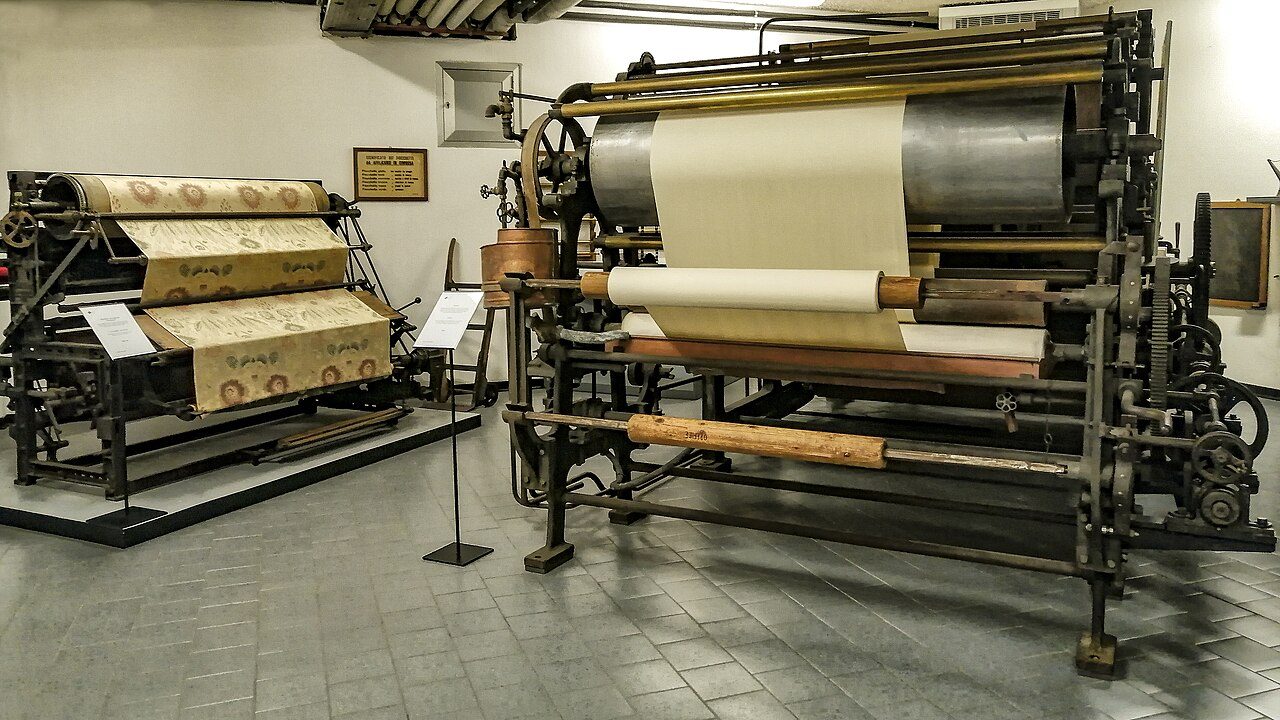
In the last part of the route, in front of the big machine with rollers
The last step before sale. The fabric is pressed, pleated or given a moiré effect: this is where silk takes on its final look and feel.
Spot the detail
The fabric running between the rollers of the biggest machine: what is happening to it?
The full story
You are at the end, and the end of silk is a matter of touch. The fabric has been reeled, twisted, woven, dyed or printed, but it is not ready yet.
What it lacks is uniformity: the quality that makes one length identical to the next and all of them just what the customer expects. Providing it is the job of .
The machine that irons
The machine that dominates the room is called a Palmer and dates from 1932. Essentially, it irons. The fabric runs through a system of rollers, between cylinders filled with hot water, and comes out smooth. But it is more than ironing: by adjusting the running speed and the pressure you get different effects on the same cloth.
Then look for the smaller machines, because they do the most curious things. One is wooden, and old, and is used for moiré, the watered effect: an optical effect that gives the surface of silk its distinctive shimmer. Another is a pleating machine, which sets a series of folds into the cloth and gives it volume.
None of these operations adds a thread or a color. They change the way silk reflects light, the volume it takes on, the feel under your fingers. It is the reason two silks woven the same way can seem like different fabrics.
What you have seen
Before you head back up, line up what you have seen. A caterpillar, a basin of hot water, a wooden mill, a loom that reads punched cards, an oven, a copper vat, a carved board, a gigantic iron. Each step had its own trade and its own factory. Put together, they were a city.
That city still exists. Silkworms are no longer raised here, but dyeing, printing and are still done in Como, and according to the museum more than 70 percent of the silk that reaches Europe passes through here.
In the storerooms, meanwhile, are some thirty thousand items, among them sample books, photographs and documents, most of them from firms that have closed. The rooms you have walked through are only the visible part.
About this stop
Record
Moiré: thirty tons for a shimmer
In the last part of the Museo della Seta, Como's silk museum, an old wooden machine serves a single effect: moiré, the watered look, those veins that seem to move across silk. It is neither a pattern nor a color. The cloth was folded in two, with the weft threads of the two halves lined up perfectly. Being off by one or two threads turned the motif into a messy wave. Two workers followed it, seated face to face. Then the fabric passed between two cylinders, one heated above 100 degrees Celsius, under a pressure the catalog record puts at about thirty metric tons. Thirty tons, for a shimmer.